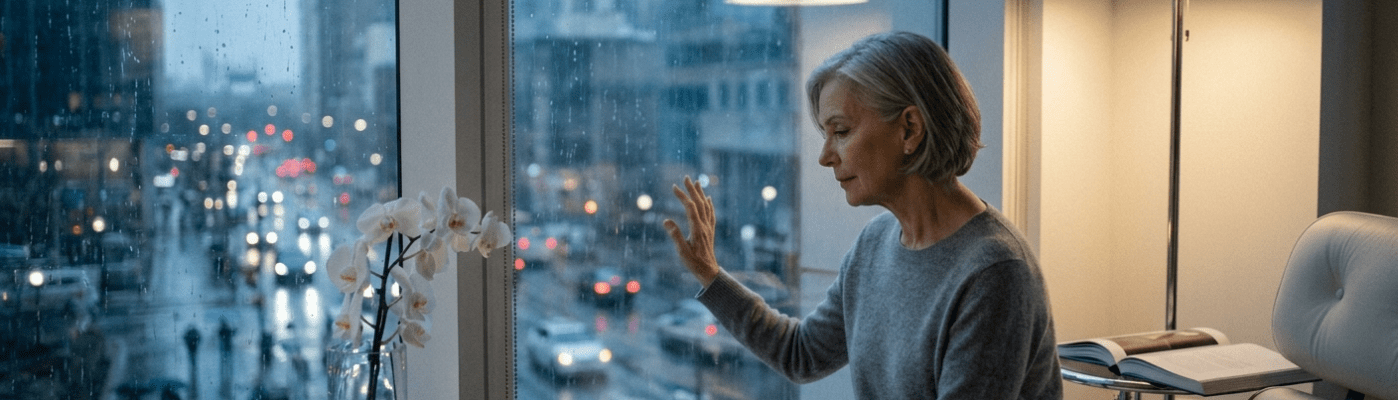
Secure your peace, but don’t live behind the glass. Money can give you a safe place to rest, but only love and purpose can give you a reason to live.
Money is a magnificent shield. It buys an unshakeable perimeter of peace by silencing survival anxiety and removing life’s structural friction.
But peace is merely a clean, quiet waiting room.
The rain outside my window does not care that it falls on a slate roof rather than a rotted canvas tarp. Inside, the radiator hums with a costly, reliable warmth. The tea in my hand is sourced from a distant valley, brewed at exactly ninety-two degrees Celsius in a kettle that cost more than my grandfather earned in a month of breaking his back in the timber yards.
By every metric the modern world values, I am safe. The anxiety that defined my twenties—the cold, hollow ache in the pit of the stomach when a car engine makes an unfamiliar sound, the calculation of pennies at the grocery register, the constant, low-grade terror of an unexpected medical bill—has been thoroughly exorcised by a comfortable bank balance. I have purchased my way out of the arena of basic survival.
Yet, as I sit in this pristine, well-lit quiet, the silence does not taste like joy. It tastes like anesthesia.
It is here, in the stillness that financial security buys, that one encounters the hardest, most deeply emotional truth of human existence: money can engineer a flawless perimeter against suffering, but it is entirely powerless to ignite the fire within it. Money brings peace, but it can never bring happiness.
To understand this distinction is to undergo a quiet heartbreak. It is the realization that the finish line we have been running toward our entire lives is not the entrance to a sanctuary of joy, but merely a very comfortable waiting room.
I. The Architecture of Peace: What the Ledger Can Buy
We must speak of peace first, because to dismiss what money can do is a privilege born of ignorance. For those who have never stayed awake until dawn, wondering how to stretch twenty dollars over seven days, it is easy to romanticize poverty as a state of rustic simplicity. It is not. Poverty is a thief of cognitive bandwidth. It is a relentless, grinding noise that drowns out the soul’s capacity to ponder anything beyond immediate survival.
Money, therefore, is a magnificent shield.
When you possess financial abundance, you purchase a specific, invaluable commodity: the absence of structural friction.
[ Financial Security ] │ ├─► Absolves: Survival Anxiety (Rent, Bills, Healthcare) ├─► Buys: Time & Autonomy (The power to say "No") └─► Creates: A Neutral Void (Silence, Space, Stability)
Money buys the ability to sleep through the night without auditing your own existence. It buys the medicine that extends a parent’s life; it buys the tuition that keeps a child from starting their adulthood in the chains of debt; it buys the freedom to leave a toxic job or a suffocating relationship without the fear of homelessness.
This is not a trivial thing. It is peace. It is the baseline of safety that allows the nervous system to finally power down from its ancestral state of fight-or-flight.
But peace is static. Peace is the clearing of the ground, the removal of the thorns, the leveling of the soil. It is a neutral void. Many of us spend decades breaking our spirits in the pursuit of wealth because we confuse this clearing of the ground with the planting of the garden. We believe that because the absence of money causes misery, the presence of money must cause its opposite.
This is the great cosmic bait-and-switch. Misery and happiness are not two ends of a single continuum; they are two entirely different landscapes. Moving out of the swamp of financial distress lands you on a smooth, dry, concrete plateau. It is safe, it is dry, and it is completely barren.
II. The Anatomy of Happiness: The Currencies of the Spirit
If peace is the absence of friction, happiness is the presence of resonance.
Happiness is not a state of security; it is a state of connection. It is the sudden, unbidden surge of warmth when a child laughs at a shared joke; it is the feeling of creative absorption when hours vanish because your hands are shaping something meaningful; it is the raw, terrifying intimacy of being truly known by another flawed human being and loved anyway.
These experiences require an entirely different currency—one that cannot be printed by central banks, stored in offshore accounts, or transferred via wire. They require the currencies of the spirit: vulnerability, presence, attention, and time.
THE TWO WALLETS├── THE MATERIAL WALLET (Money)│ ├── Peace│ ├── Insulation│ └── Control│└── THE SPIRITUAL WALLET (Presence) ├── Happiness ├── Intimacy └── Meaning
Consider the anatomy of a truly happy moment. It is almost always characterized by a loss of self-consciousness, a dissolution of the ego. You forget yourself in the beauty of a sunset, the rhythm of a song, or the depth of a conversation.
Money, by its very nature, does the exact opposite: it reinforces the ego. Wealth builds a wall around the self. It emphasizes distinction (“I have this, you do not”), fosters insulation (“I do not need to rely on my neighbor because I can hire a professional”), and prioritizes control.
You cannot buy your way into an authentic moment of joy because the moment you attempt to purchase it, you transform an act of living communion into a transaction. And transactions are dead things. They carry no warmth. They leave the participant exactly as they were: a customer standing outside the window of life, looking in at a warmth they cannot seem to possess.
III. The Isolation of the Insulated Life
There is a profound, unchronicled grief that accompanies wealth: the grief of self-reliance.
In our poverty or our modest beginnings, we are forced to rely on one another. The human tribe was forged in the fires of mutual dependence. We needed our neighbors to help us move; we needed our aunts to watch the kids; we needed the community to rally when the harvest failed or the roof leaked. In that forced interdependence, something beautiful was accidentally cultivated—belonging.
When money increases, the need for the tribe decreases.
Instead of asking a friend for a ride to the airport, you call an executive car service. Instead of asking your brother-in-law to help fix the deck, you hire a contractor. On the surface, this feels like a victory—it is efficient, it avoids social obligation, and it preserves your autonomy.
But beneath that surface, a slow, systemic poisoning occurs. Each transaction cuts an invisible thread connecting you to the social fabric. You become an island. A beautiful, perfectly manicured, highly secure island with a state-of-the-art security system—but an island nonetheless.
“Wealth protects us from the world, but in doing so, it protects us from the very things that could heal us.”
When you no longer need anyone, you begin to doubt if anyone truly needs you, or if they simply need what you can provide. The wealthy person is haunted by a chronic, low-grade paranoia: Do they love me for my soul, or are they basking in the warmth of my fire?
This doubt is a solvent that eats away at the foundation of intimacy. It makes a person guarded, transactional, and cynical. And a cynical heart can find peace through isolation, yes, but it can never, ever taste the sweet, reckless abandon of true happiness.
IV. The Hedonic Treadmill and the Illusion of “More”
Why, then, do we continue to pursue wealth with such manic intensity even after our peace has been secured? Because the human brain is easily deceived by the phenomenon of adaptation.
When we achieve a new financial milestone, the initial relief—the peace—feels so profound that it mimics happiness for a brief window. The first month in the larger house feels like a victory; the first year with a six-figure salary feels like a liberation.
But the mind is a master of normalization. Within a stunningly short period, the luxury becomes the baseline. The slate roof becomes just a roof; the reliable radiator becomes just background noise. The peace remains, but the feeling of elevation evaporates.
THE CYCLE OF EXPECTATION [ Financial Milestone Achieved ] ──► [ Brief Window of Relief/Peace ] ▲ │ │ ▼ [ Baseline Shifts (Normalization) ] ◄── [ Mind Normalizes Comfort ]
Because we don’t understand the difference between peace and happiness, we look at our return to an emotional baseline and misdiagnose the problem. We think: Ah, I am still not happy. That must mean my shield is not big enough. I need a bigger house. A faster car. A higher net worth.
We run faster on the treadmill, burning our precious, non-renewable years on earth to buy more insulation, more control, and more safety. We sacrifice the very things that generate happiness—our health, our marriages, the golden years of our children’s childhoods, our creative callings—in service of a god that can only return a receipt of safety, never a guarantee of joy.
It is a tragedy enacted in slow motion across millions of lives: we kill the things that make us happy to buy protection from the things that make us miserable.
V. The Synthesis: Walking the Middle Path
To see this truth clearly is not an invitation to despair, nor is it a call to abandon the material world and adopt a life of ascetic poverty. Money is a tool of immense utility. To pretend otherwise is an insult to those who suffer under its absence.
The wisdom lies in synthesis. It lies in assigning money its proper, dignified place in the hierarchy of existence, while fiercely protecting the territory it cannot touch.
| Attribute | The Domain of Money (Peace) | The Domain of the Spirit (Happiness) |
| Primary Goal | Eradication of suffering and survival anxiety | Cultivation of connection, purpose, and wonder |
| Mechanism | Control, insulation, efficiency, transactions | Vulnerability, presence, surrender, attention |
| The Danger | Hyper-isolation, cynicism, endless accumulation | Vulnerability to external shocks, systemic stress |
| The Result | A safe, quiet, predictable baseline | A vibrant, unpredictable, deeply felt life |
We must use money to build the foundation of our house. We should use it to pay our bills, secure our health, buy our time back, and silence the wolf at the door. We should accept the peace it offers with deep, unreserved gratitude. It is a beautiful thing to look at a storm outside and know your roof will not leak.
But once the foundation is laid, we must drop our tools and remember how to build the rooms above it.
We must understand that the furniture in those rooms cannot be delivered by an online retailer. The warmth of those rooms cannot be regulated by a thermostat. The beauty of those rooms must be painted with the messy, unpredictable, uncontrolled strokes of human engagement.
VI. The Final Reckoning
As the night deepens, the rain outside turns to a quiet mist. The radiator clicks off, leaving the room in a silence so profound it feels heavy.
If I were to lose everything tomorrow—if the ledger were wiped clean and the slate roof taken away—I would grieve. I would feel the return of that old, terrifying friction. Anyone who says otherwise has forgotten the cold.
But as I look around this beautiful, expensive room, I know with absolute certainty that if I die tomorrow, the things that will flash before my eyes will not be the numbers in my portfolio, the brand on my watch, or the quiet security of my neighborhood.
I will see my friend laughing so hard he couldn’t breathe at a cheap diner table fifteen years ago. I will see the tear sliding down my partner’s cheek during a quiet confession made in the dark of a bedroom that didn’t belong to us. I will see the rough, calloused hands of my father holding a cheap wooden bird he carved for me out of scrap pine.
Those memories were not bought. They lived. They were moments where I dropped my shield, allowed myself to be vulnerable, and stepped out of the safety of my own insulation into the wild, dangerous, gorgeous currents of existence.
Money can buy you the privilege of sitting comfortably by the window, watching the world go by without getting wet. But happiness requires you to open the door, step out into the downpour, and risk losing your balance entirely. It is a hard truth, an emotional truth, but it is the ultimate truth of our short, fragile lives: money can give you a place to rest, but only love, connection, and purpose can give you a reason to live.


I’m passing this forward to my readers on the Substack platform 👌
LikeLiked by 1 person
Thanks 🙏 and have a blessed day.
LikeLiked by 1 person