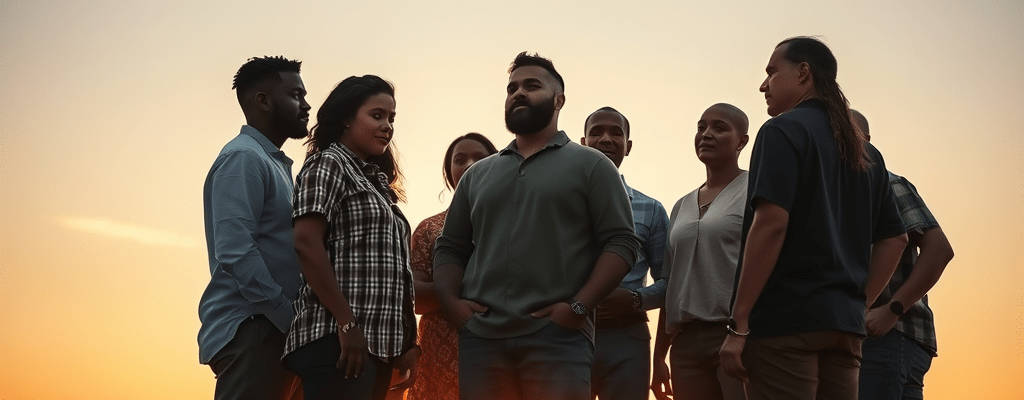
No two lives begin alike, yet all share a horizon beyond measure. Equality is not sameness of fate or circumstance; it is the unseen truth that every existence flows from the same well of worth. “All are created equal” does not name the world we see—it names the world we are called to build, one where dignity is honored as the common ground of humanity.
No life is lesser, no soul expendable. True equality is not sameness—it is the sacred worth we all carry beneath every difference.
Introduction: The Weight of a Phrase
Few phrases in human history have carried such immense moral gravity while simultaneously bearing such contradiction as “All men are created equal.” At once, it has been hailed as a self-evident truth and exposed as a glaring falsehood. It has served as a rallying cry for freedom, justice, and reform, and yet has been penned, spoken, and defended by societies that denied its promise to many. Its truth has never been simple, for it rests not in describing reality but in pointing us toward a horizon of what humanity could be.
The enduring power of the phrase lies not in its author, its historical context, or its political utility, but in its universal resonance. It touches something primal and perennial in human consciousness: the intuition that no life is inherently superior to another, that the worth of a being does not rest on wealth, power, race, gender, or circumstance, but on the fact of existence itself.
To unfold the truth behind these words, we must move beyond their origins and enter into their philosophical, spiritual, and moral depths. We must ask not only what equality means in law or politics, but what it means in the essence of being human.
The Universal Longing for Equality
Across cultures and epochs, the intuition of equality surfaces. Ancient wisdom traditions, oral stories, and spiritual teachings have carried variations of the idea: that all lives possess a shared sacredness, that the measure of worth cannot be monopolized by kings or castes.
The Stoics of ancient Greece and Rome declared that all human beings participate in the same divine reason (logos). The Buddhist tradition teaches that all beings are caught in the same cycle of suffering and rebirth, and therefore, compassion must extend universally. In African proverbs, we hear the reminder: “The child of your neighbor is also your child.” Indigenous traditions speak of the interwoven web of life, where every being, human or not, belongs to the circle.
This universal longing arises because humans, despite differences, sense the fragility and dignity of life itself. We see our vulnerability mirrored in one another: the shared breath, the shared mortality, the shared hope. Equality is not the denial of difference but the recognition of shared essence.
The Paradox of Human Difference
Here lies the paradox: though equal in dignity, we are unequal in circumstance. Some are born into privilege, others into poverty. Some inherit health, others disease. Some are gifted with extraordinary talents, while others struggle for survival.
This paradox has often been misused. Hierarchical societies argue that natural differences justify social inequalities: that some are born to rule and others to serve. Yet difference in ability, fortune, or circumstance does not negate equality of worth. Equality does not mean sameness—it means that the uniqueness of each being does not diminish its value.
In truth, the phrase “created equal” is less about eliminating difference and more about restraining arrogance. It is a reminder that no matter how great our talents, wealth, or power, we do not rise above the intrinsic dignity of another life.
The Moral Dimension of Equality
Equality, then, is not an empirical fact but a moral principle. We cannot measure equality in physical traits, wealth, or social roles, but in the recognition that every person carries an inalienable dignity that must be respected.
This is why societies encode equality into laws, declarations, and constitutions. Without the moral compass of equality, power devours, and the strong exploit the weak. The idea of equality stands as a counterweight to human ambition and domination. It is not descriptive—it is prescriptive. It is the demand that we treat others not according to what they can offer us, but according to what they are: beings of inherent worth.
Equality Across Time and Civilizations
Though phrased differently, many civilizations have articulated the same truth:
- The Stoics wrote, “A man is your brother, not because he shares your blood, but because he shares reason.”
- In early Christianity, Paul wrote, “There is neither Jew nor Greek, slave nor free, male nor female, for you are all one.”
- In Islam, the Prophet Muhammad declared, “All mankind is from Adam and Eve. An Arab has no superiority over a non-Arab, nor does a white have superiority over a black, except by piety and good action.”
- In Confucian thought, while hierarchies existed, the essence of humaneness (ren) demanded respect across differences.
- In African Ubuntu philosophy: “I am because we are”—the self only exists in relation to the equal dignity of others.
Every culture, in its highest wisdom, circles back to the same recognition: difference does not cancel equality, it completes it.
The Struggle Between Power and Equality
Yet, throughout history, power resists equality. Hierarchies are built because equality threatens privilege. Those who benefit from domination often clothe inequality in ideology: caste, race, divine right, class, and gender norms.
Equality, therefore, has always been born in struggle. It has to be demanded, fought for, and lived into existence. The enslaved demand freedom, the oppressed demand rights, the silenced demand a voice. The phrase “all men are created equal” has been less a declaration of arrival and more a trumpet call to rebellion against injustice.
Modern Interpretations of Equality
In the modern world, the debate continues: what does equality mean?
- Equality before the law: that every person, regardless of status, is subject to the same rules and protections.
- Equality of opportunity: that every person should have access to the same chances for education, work, and flourishing.
- Equality of outcome: a more radical vision, where disparities in wealth, status, and power are corrected to ensure fairness.
Each interpretation provokes debate. Some argue that equal rights are enough; others claim that without equity, formal equality is meaningless. The conversation evolves, but the guiding principle remains: no one’s dignity is worth more than another’s.
The Psychological Depth of Equality
Beyond law and politics, equality requires inner transformation. Human beings are prone to comparison, competition, and hierarchy. Ego craves superiority; fear clings to difference.
True equality begins with seeing beyond the surface. It requires humility: the recognition that one’s own life is no more sacred than another’s. It involves compassion: the ability to imagine oneself in another’s place. It requires awareness: the courage to dismantle unconscious biases that feed superiority.
Inequality is not only systemic—it is psychological. To live in equality is to transform the heart.
The Spiritual Truth of Equality
At its deepest level, equality is a spiritual truth. To say that all men are created equal is to say that every being shares a divine spark, a unique but equal share of sacred worth.
- In Buddhism, all beings are equal in their capacity for enlightenment.
- In Hindu thought, the atman (soul) is of the same essence in every being, a reflection of Brahman.
- In Christianity, every soul is beloved by God without regard to hierarchy.
- In Indigenous traditions, humanity is part of a sacred web where no being is lesser.
The spiritual truth unites them: we are bound not by sameness but by sacredness.
The Future of Equality
As we look forward, the concept of equality faces new challenges. Technology threatens to create new hierarchies of power—those with access to advanced AI, biotechnology, and resources may stand far above others. Climate change and global inequality remind us that while some live in abundance, others suffer in scarcity.
Yet the principle of equality remains urgent. In a world where differences can easily divide, equality calls for solidarity. It reminds us that dignity is indivisible: when one is diminished, all are diminished.
Conclusion: The Guiding Flame
“All men are created equal” is not a historical artifact but a living challenge. It was never a description of the world—it was, and remains, a moral horizon.
Its truth lies not in uniformity but in dignity. Not in sameness, but in sacred worth. Not in what has been achieved, but in what we are called to pursue.
Equality is the compass of justice, the anchor of compassion, the light against tyranny. It asks of us not only fair laws but transformed hearts. It asks us to see in every face—friend, stranger, enemy alike—the same irreducible spark.
The real truth is simple and eternal: human beings differ in every measurable way, but in dignity, they are the same. To honor that truth is to walk toward wisdom. To ignore it is to live in illusion.
“All men are created equal” is not the world we inherit. It is the world we are meant to build.


Very interesting read.
LikeLiked by 1 person
Thanks for sharing your thoughts 🙏
LikeLiked by 1 person
A post much needed for these times of divisiveness.
LikeLiked by 1 person
Thanks so much for sharing your awesome feedback ☺️
LikeLike