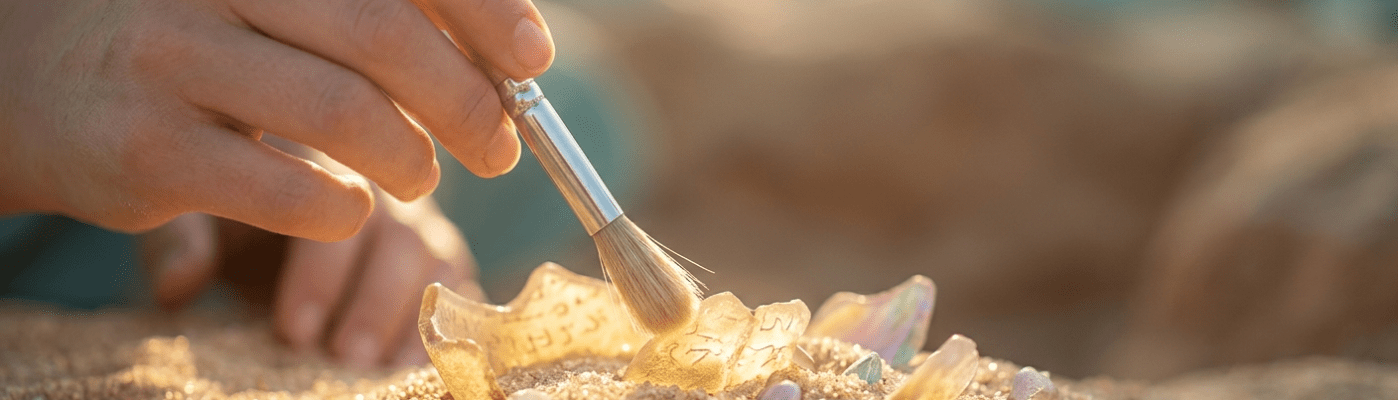
Have you ever noticed that your best ideas never show up when you’re shouting at your brain to be brilliant? Most of us were taught that to find the ‘gold’ in our lives—our purpose, our joy, our big break—we need to pick up a shovel and dig until our hands bleed. But what if the things we are searching for aren’t buried deep? What if they are actually quite fragile? If you use a shovel where you should have used a brush, you don’t find the treasure—you only find the fragments of what it could have been.
Take a deep breath. Now, imagine that everything you’ve been frantically searching for isn’t hiding from you—it’s just waiting for you to be gentle enough to receive it. We often think the ‘hustle’ is what gets us closer to our goals, but in the world of the soul, pressure is actually the very thing that buries the prize deeper.
The Myth of the Harder Dig
We live in a world that is obsessed with the “strike.” We are taught from a young age that life is a series of extractions. We extract grades from schools, we extract performance from our bodies, and we attempt to extract “purpose” from our souls as if it were oil buried deep in the earth. We are raised to be miners—loud, heavy-handed, and perpetually in a rush.
The cultural mantra is simple: If you haven’t found what you’re looking for, you aren’t digging hard enough. But there is a profound, quiet truth that the most fulfilled among us eventually discover: The most valuable treasures in the human experience—wisdom, love, creativity, and inner peace—are not mineral; they are organic. They are not stones to be hammered out of the dark; they are delicate artifacts of the spirit.
When we apply the “shovel” of pressure to these fragile things, we don’t just find them—we crush them before we even have the chance to understand their value.
To live an inspired life, we must undergo a radical shift in our approach. We must trade the shovel for the brush. We must learn the art of “Dusting for Dreams.”
I. The Archaeologist’s Paradox: Force Destroys Context
To understand why pressure is the enemy of discovery, we must look at the literal work of archaeology. When an explorer finds the edge of something ancient beneath the sand, they don’t call for a bulldozer. They get down on their knees. They use tools made of soft hair and fine bristles.
1. The Fragility of Truth
The more significant a discovery is, the more likely it is to be fragile. Think of the “Aha!” moments in your life. They rarely happen when you are screaming at yourself to be brilliant. They happen in the shower, on a walk, or in that half-awake state before the sun rises. These moments are “artifacts.” If you rush them, or demand they fit into a specific box (like a business plan or a social media post) before they are ready, they shatter.
2. The Loss of Context
In archaeology, the “where” and “how” an object is found is often more important than the object itself. When we use pressure—when we demand an answer now—we rip the treasure out of its context. You might get the “answer” you wanted, but you lose the lesson that was supposed to come with it. You get the destination, but you realize you’ve forgotten why you wanted to go there in the first place.
II. The Psychological Cost of the “Shovel” Mindset
Why are we so addicted to pressure? Why is it our default setting? It’s usually driven by three internal shadows: Fear, Comparison, and Control.
1. Fear of the Void
We dig frantically because we are afraid of what will happen if we don’t find something. If I’m not “achieving,” who am I? We use the noise of the shovel to drown out the silence of the search. But discovery requires silence. It requires the dust to settle so you can see the ground clearly.
2. The Comparison Trap
We see others on social media standing over their “chests of gold” and we feel behind. We think, “They found their treasure at 25, why am I still dusting at 40?” This external pressure turns a journey of wonder into a race of desperation. But your treasure is tuned to your frequency. You cannot find someone else’s gold, and they cannot find yours.
3. The Illusion of Control
Pressure is our way of trying to control the uncontrollable. We think that if we are stressed, we are “working.” We mistake tension for progress. But as anyone who has ever had “writer’s block” knows, you cannot command the Muse. You can only set the table and wait for her to arrive.
III. The Three Stages of Gentle Discovery
If we are to stop “mining” our lives and start “dusting” for our dreams, we need a new framework. This is the process of The Gentle Explorer.
Stage 1: The Soft Gaze (Observation)
In physical trekking, if you stare too hard at one spot, your peripheral vision disappears. The same is true for your mind. When you are hyper-focused on a specific goal (e.g., “I must make $100k this year”), you become blind to the “miracle on the side of the road” that might have led you to a much happier path.
- The Practice: Spend time looking at your life without a goal. What makes you smile when no one is watching? What do you do when you’re “wasting time”? These are the edges of your buried treasure.
Stage 2: The Delicate Brush (Patience)
Once you find a hint of something—an interest in gardening, a new business idea, a spark for a relationship—do not try to pull the whole thing out at once. Dust it. * The Practice: Ask small, low-stakes questions. “What if I tried this for one hour?” “What does this feel like?” By removing the pressure of “success,” you allow the idea to reveal its true shape to you.
Stage 3: The Slow Reveal (Integration)
The final stage is allowing the discovery to change you. When we use pressure, we try to change the treasure to fit us. When we use the brush, we allow the treasure to change us.
IV. From “Mining” to “Gardening”
To sustain this mindset, we have to change our internal metaphor. A miner extracts; a gardener cultivates.
- The Miner says: “What can I get from this day?”
- The Gardener says: “What can I grow in this day?”
A gardener knows that you cannot command a seed to grow. You cannot yell at a sprout to become an oak tree. You simply provide the soil, the water, and the light, and then you trust the process. On LifeInspiration4All, we recognize that “Trusting the Process” isn’t a passive act. It is an active, daily choice to keep the pressure off your own soul. It is the bravery required to be patient in a world that is obsessed with speed.
V. Applying the “Brush” to Different Areas of Life
How does “Dusting for Dreams” look in the real world?
In Relationships
Stop trying to “solve” the people you love. Stop pressuring them to be the version of themselves you’ve imagined. When you apply pressure to a partner or a child, they build walls to protect their “treasure.” If you want to discover who they truly are, put down the shovel of expectation. Start dusting. Watch them. Listen to the things they don’t say. You will find a much more beautiful person than the one you were trying to “build.”
In Career and Creativity
We often treat our careers like a ladder to be climbed with brute force. But what if your career is a landscape to be explored? If you feel burnt out, it’s because you’ve been using a shovel for too long. Try “dusting” a new skill or a side project with zero expectation of profit. Often, the thing we do “just for fun” is the very thing that eventually becomes our greatest contribution.
VI. The Wisdom of the “Small Find”
In the “Shovel” mindset, if it isn’t a massive chest of gold, it isn’t worth it. But in the “Brush” mindset, we learn the Wisdom of the Fragment.
Sometimes, we only find a single coin. Sometimes, we only find a piece of a story.
- Do not throw away the fragment because it isn’t the whole.
- Do not judge your progress by the size of the find.
A single coin is proof that gold exists. A single moment of peace is proof that a peaceful life is possible. When you stop pressuring yourself to find the “whole thing” today, you become free to enjoy the clues you find along the way.
VII. Conclusion: The Joy of the Uncovered Life
The greatest treasure you will ever find is not at the bottom of a hole you dug with sweat and tears. It is the person you become when you finally learn to be still.
When you put down the shovel, the dust begins to settle. And when the dust settles, the world becomes clear. You realize that the “treasure” wasn’t something you had to find; it was something that was waiting for you to stop burying it under the weight of your own urgency.
For everyone reading this on LifeInspiration4All: You are not behind. You are not failing. You are simply in the “dusting” phase of your journey. Trust your hands. Trust the brush. And most importantly, trust that the dream you are looking for is already looking for you. It is just waiting for a hand gentle enough to touch it without breaking it.
Put down the shovel. Pick up the brush. The discovery starts now.
 Life Inspiration