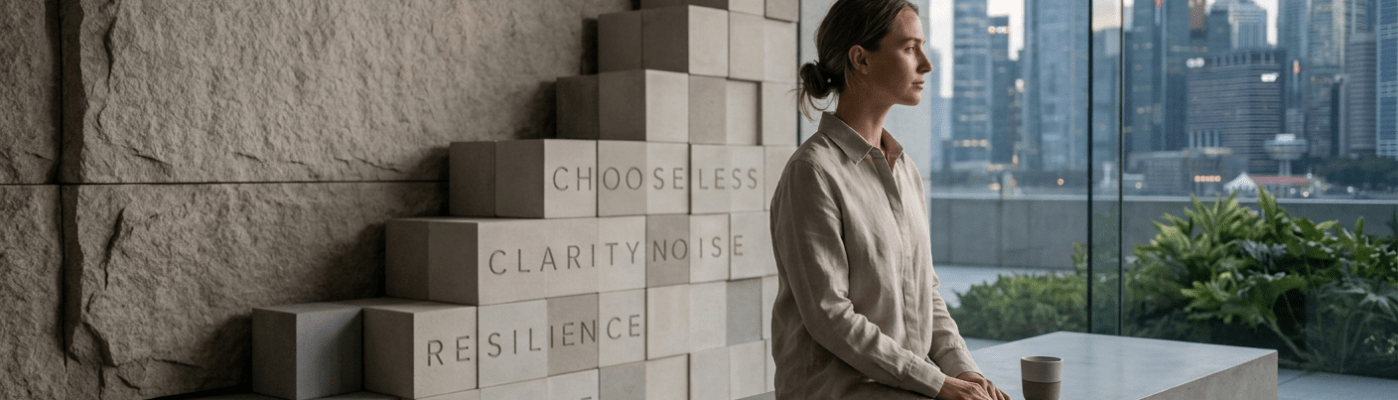
We live in an era where noise is frequently mistaken for importance. The loudest voice in the room is assumed to be the most confident; the person who constantly posts, reacts, and explains is seen as the most relevant. Visibility has become a global currency, and silence—often misunderstood as absence—has been devalued.
But there is a truth most people only discover once they are exhausted from performing their lives: Silence is not weakness. It is control.
The Shift from Performance to Presence
There comes a moment when you realize that constantly explaining yourself is draining your identity. Reacting to every external stimulus dilutes your focus, and trying to be heard by everyone eventually disconnects you from yourself.
This is where the shift begins. Choosing less noise is not about disappearing from the world; it is about returning to yourself. It is the act of reclaiming your attention, your energy, and your direction. Learn more about Reclaiming Your Personal Power on our blog. Because while noise distracts, silence builds.
The Foundation of the Unseen
Every strong structure begins in the quiet. Before a building stands tall or becomes a subject of admiration, it exists in the “blueprint stage.” There is no applause for the foundation, yet that is where the integrity of the entire project is decided.
Our lives function the same way. We often feel pressured to narrate our journeys in real time to show progress or justify our pauses. But this constant need to “show” interrupts the deeper work of “becoming.” When you step away from the noise, you finally start hearing your own thoughts. You notice the cracks that need repair and the goals that actually matter to you. Check out our guide on Setting Intentional Goals to start your blueprint stage.
Why We Fear the Quiet
Most people avoid silence not because it is empty, but because it is honest. Noise is a convenient distraction; it keeps us busy enough to avoid confronting the essential questions: Am I truly happy? Am I living intentionally?
Silence removes the escape routes. It forces a confrontation with your thoughts, doubts, and potential. While that discomfort can be jarring, it is the only doorway to true clarity. Without external interference, you begin to understand your own patterns, your draining relationships, and your untapped strengths. Silence is not empty; it is full of the answers most people are too distracted to hear.
The Economy of Words
In a world of constant reaction, the person who speaks with intention stands out without effort. When you reduce the noise, your words naturally gain value. This is the Economy of Words. Instead of treating speech like an unlimited resource, you begin to treat it like currency. You spend it carefully and invest it where it actually carries weight. Interestingly, people tend to listen more intently when you say less. Silence creates a specific kind of presence that commands attention without needing to force it.
Silence as a Boundary
One of the most practical benefits of choosing less noise is learning that not every conversation deserves your response. Silence becomes your filter. It allows you to detach from performative interactions and protect your finite mental energy.
In a digital world that demands constant engagement, silence is your gatekeeper. It allows you to prioritize what deserves your focus and, more importantly, what does not. Explore our tips for Digital Wellness and Mindfulness for a quieter mind.
The Quiet Confidence
Real confidence doesn’t need to prove itself. While many associate confidence with dominance or loudness, the most unshakable version of it is quiet. It shows up as being comfortable without external validation and trusting your decisions without needing to explain them.
When you choose less noise, you stop performing confidence and start embodying it. You no longer need to convince others of your worth because you have already solidified it in the quiet. This internal resilience ensures your value doesn’t fluctuate based on how much attention you receive.
Living Intentionally, Not Invisibly
Choosing silence doesn’t mean living a small life; it means living an intentional one. It is the understanding that not everything needs to be shared, documented, or announced.
You stop chasing visibility and start pursuing alignment. The “white space” in your life—the quiet moments and the deliberate pauses—becomes just as valuable as your visible achievements. This is where your true identity is shaped.
How to Practice the Quiet
Silence is a discipline. If you are ready to choose less noise, start with these five pillars:
- Create Daily Stillness: Dedicate 15 minutes to being without input—no phone, no music, no talk.
- Reduce Reactivity: Practice a “five-second pause” before responding to messages or opinions.
- Curate Consumption: Be ruthless about what digital noise you allow into your mental space.
- Stop Over-Explaining: Realize that “No” or your chosen path doesn’t always require a footnote.
- Embrace Being Misunderstood: Accept that your internal growth doesn’t require external comprehension.
Conclusion: Purpose Over Performance
Noise is easy. In a world of digital echoes, anyone can fill a room with sound or a social media feed with content. It takes no effort to react, to shout, or to perform. But silence? Silence requires self-awareness. It requires the grit to stand still while the rest of the world is running in circles.
When you choose silence, you aren’t losing your voice; you are sharpening it. You are choosing:
- Depth over distraction.
- Clarity over chaos.
- Purpose over performance.
By stepping back from the noise, you stop building a life for the “audience” and start building one for the individual. You are constructing a life guided by internal truth rather than external pressure. It is a life that values the substance of the soul over the volume of the broadcast.
And that kind of life? It doesn’t need to be loud to be powerful. It just needs to be yours.
Frequently Asked Questions (FAQ)
Does choosing silence mean I’m being anti-social? Not at all. It means being selectively social. It’s moving from “quantity” to “quality” in your interactions. It’s choosing to engage deeply with a few things rather than shallowly with everything.
How do I handle people who think my silence is a problem? People often interpret silence based on their own insecurities. If someone views your quietness as “shyness” or “anger,” that is their projection. You don’t owe them an explanation for your peace.
Is silence the same as “The Silent Treatment”? No. The silent treatment is a tool used to punish or manipulate others. The silence we are discussing here is a tool used to nourish and protect yourself. One is a weapon; the other is a sanctuary.
How can I be silent in a job that requires me to talk? Silence isn’t just about the absence of speech; it’s about the absence of noise. You can be communicative at work while remaining silent regarding office gossip, unnecessary drama, and the need to over-share your personal life.
 Life Inspiration