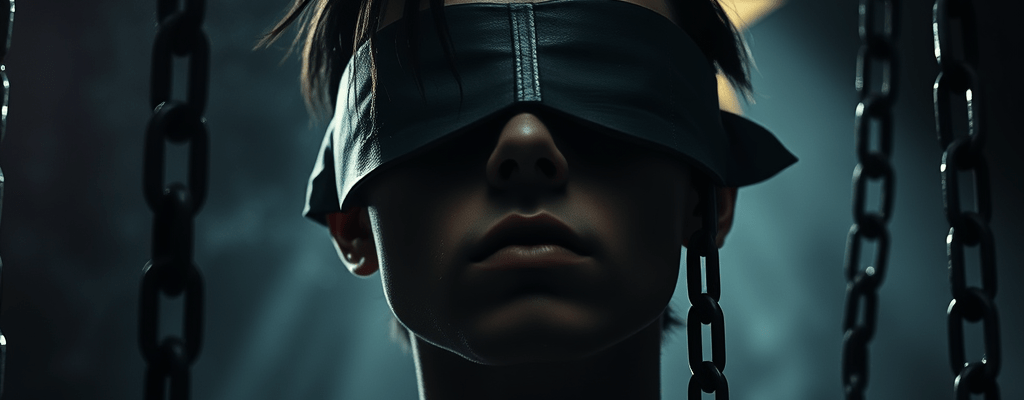
The Weight of Unseen Anchors: The Dark Reality of Blind Faith. In an era defined by endless information, blind faith has not weakened—it has adapted. When thinking becomes exhausting, belief becomes automatic. Algorithms now guide conviction the way doctrine once did, shaping what we trust without requiring our awareness.
Blind faith has outgrown its religious origins and embedded itself as a modern psychological anchor. Framed as virtue, it quietly restrains the human spirit, demanding the surrender of critical thinking to institutions, ideologies, and algorithms. In exchange for certainty, personal agency is traded for a fragile sense of security. Growth begins only when these unseen anchors are recognized—and when the uncomfortable, yet liberating, responsibility of independent thought is reclaimed.
Table Of Contents
- The Cognitive Fortress: Why We Choose Blindness
- The Illusion of Motion: Activity vs. Growth
- The “Nuremberg of the Soul”: The Erosion of Agency
- Modern Dogma: From Ancient Altars to Digital Algorithms
- The Psychological Fracture: Silence and Dissonance
- Choosing the Weight of Conscious Belief
- Final Reflection: The Courage to Be Unmoored
The Cognitive Fortress: Why We Choose Blindness
Blind faith rarely announces itself as a danger. It enters as a sanctuary—warm, familiar, and infinitely reassuring. To understand the consequences of blind faith, we must first understand its biological allure. The human brain is evolutionarily wired for “efficiency,” which often means seeking patterns and minimizing “cognitive load.” In an era of polycrisis—economic instability, rapid technological shifts, and social upheaval—the mental energy required to interrogate every truth we encounter is exhausting.
Blind faith offers a pre-packaged reality. It provides what psychologists call “cognitive closure”—the desire for a definitive answer to alleviate the anxiety of the unknown. When we adopt a dogmatic belief system, we create a cognitive silo. Within this silo, every “why” has a definitive “because.” This absolute certainty acts as a psychological sedative, numbing the existential dread of an indifferent universe.
However, the price of this sedative is intellectual stagnation. When reality begins to contradict our beliefs, we experience cognitive dissonance. Rather than adjusting the belief to fit the facts, blind faith compels the individual to ignore the facts to save the belief. This creates a “fortress of the mind” where the individual stops seeking truth and starts seeking only validation. The unseen anchor here is the cessation of growth; we trade our capacity for enlightenment for the safety of a closed loop.
The Illusion of Motion: Activity vs. Growth
One of the most insidious qualities of blind faith is that it mimics the sensation of progress. A person caught in its grip may feel they are ascending—spiritually, morally, or socially. They attend the rituals, master the vocabulary, and defend the cause with fervor. They are busy, and in our culture, busyness is often mistaken for purpose.
But we must distinguish between horizontal movement and vertical growth. Unseen anchors work by allowing motion within a strictly defined radius. You are permitted to move, but only in approved directions. You may ask questions, but only “safe” ones that reinforce the existing structure. This is the difference between a ship sailing the open sea and a ship circling a harbor on a short chain. True growth requires friction—the tension between what we were taught and what we observe, between inherited truths and lived experience.
Blind faith short-circuits this friction. It labels discomfort as a moral failure and inquiry as a threat. Over time, this creates individuals who are deeply convinced yet poorly examined. They are passionate, yet fragile; certain, yet afraid—because certainty that cannot withstand questioning is always on the brink of collapse. The tragedy is not that blind faith asks us to believe, but that it asks us to stop becoming.
The “Nuremberg of the Soul”: The Erosion of Agency
The dark reality of blind faith eventually manifests as a societal crisis. When faith becomes blind, the individual undergoes a process of moral outsourcing. This is the “Nuremberg of the Soul”—the abdication of personal responsibility under the guise of higher devotion.
- The Abdication of Ethics: If a system, leader, or political party is viewed as infallible, the individual no longer needs to grapple with the nuance of right and wrong. “Good” is simply what aligns with the dogma; “Evil” is anything that threatens it.
- The Loss of Accountability: Blind faith allows people to bypass their own conscience. Whether it is a religious cult, a radical political movement, or a toxic corporate culture, it enables the individual to say, “I am not responsible; I am merely an instrument of the faith.”
By tethering our moral compass to an unseen anchor, we lose our personal agency. We become tools in the hands of those who command the narrative, capable of justifying profound harm because we have ceased to see ourselves as the authors of our own actions. This erosion of agency is how “good people” end up supporting systems of exclusion or destruction.
Modern Dogma: From Ancient Altars to Digital Algorithms
In the 21st century, the “unseen anchor” has shed its traditional religious robes. Blind faith has migrated from the pulpit to the algorithm. Today, we see a “New Digital Dogma” where data is treated as scripture and software architects are the new priesthood.
We see the dark reality of blind faith in:
- Political Tribalism: Where “the other side” is inherently wrong, and “our side” is beyond reproach, regardless of the evidence.
- Echo Chambers: Where algorithms feed us only what we already believe, reinforcing the anchor’s grip by shielding us from contradictory viewpoints.
- Influencer Culture: Where charisma is mistaken for character, and millions follow “blueprints” for life without questioning the foundation of those claims.
In an age of information overload, critical thinking has become a rare and taxing labor. When the cognitive load is too heavy, belief becomes automatic. We adopt opinions we didn’t examine and defend narratives we didn’t vet, simply because they provide a sense of moral clarity in an overwhelming world. The anchors have become digital, but they hold us just as fast.
The Psychological Fracture: Silence and Dissonance
The damage of unexamined belief is not just societal; it is deeply personal. When we suppress doubt, we are forced to suppress our intuition. When we ignore inner conflict, we sever our connection to self-trust. This creates a subtle, painful fragmentation—the “Public Self” that performs belief to maintain belonging, and the “Private Self” that wonders, questions, and grieves.
This inner division breeds anxiety, guilt, and shame. Not because the individual is broken, but because they are human—wired to adapt and seek coherence. Blind faith demands coherence without integration. It asks people to silence parts of themselves rather than understand them. The result is not peace; it is a quiet dissonance, a sense that one’s identity is built on sand. Because certainty that cannot withstand questioning is inherently fragile, the individual becomes increasingly defensive, perceiving every external critique as an existential threat.
Choosing the Weight of Conscious Belief
Is the solution to abandon faith entirely? Not necessarily. The tragedy of the unseen anchor is not the presence of faith, but the absence of inquiry. The path to freedom lies in moving from blind surrender to conscious faith.
- Conscious faith welcomes the light of awareness. It is a bridge built over an abyss, requiring constant maintenance and the courage to acknowledge the depths below. It is resilient because it has been tested by fire.
- Blind faith is a refusal to admit the abyss exists. It is brittle because it relies on the avoidance of reality.
The moment the anchor becomes visible is often a “dark night of the soul.” A belief fails to explain suffering; a leader betrays trust; reality contradicts the doctrine. This moment is agonizing, but it is also the threshold of rebirth. To feel the weight of the anchor is the first act of liberation. Recognition is the first act of freedom.
Final Reflection: The Courage to Be Unmoored
The radical act of the modern soul is the willingness to look honestly at what we are standing on. It is the courage to trade the heavy, dark reality of blind obedience for the lighter, yet more demanding, burden of self-authored truth.
Letting go of the anchor does not mean drifting aimlessly. It means learning to navigate. It means accepting that certainty is a horizon we never quite reach, but the pursuit of it is what makes us human. Faith that survives the fire of questioning is no longer a weight that pulls us down; it is a foundation that allows us to rise.
Because a faith that is earned is the only one that can truly set us free.
Join the Conversation
The unexamined belief is an anchor; the questioned truth is a sail. Which “unseen anchors” have you had to cut in your own life? Is there a belief you once held with absolute certainty that you have since outgrown? Share your journey of “unlearning” in the comments below—let’s start a conversation about the courage it takes to be uncertain
 Life Inspiration
Nice write up.
LikeLiked by 1 person
Thanks 😊
LikeLiked by 1 person
Well written, learning to navigate and evolve, blind faith is dangerous.
LikeLiked by 1 person
Thanks for your feedback ☺️
LikeLiked by 1 person